
How StakePoint Works
StakePoint is a non-custodial Solana DeFi platform that provides token locking, LP locking, and token staking through on-chain smart contracts. All user funds are held in Program Derived Addresses, on-chain accounts with no private keys that are publicly verifiable on Solscan.
StakePoint was launched in December 2025 on Solana mainnet. It supports SPL tokens, Token-2022 tokens, and LP tokens from Raydium, Meteora, Orca, and PumpSwap. Token vesting and dual-token staking launched in August 2026, and locking directly from a Squads multisig vault in October 2026. Each process below is described step by step.
Token Locker & LP Locker
StakePoint's token locker is a smart contract that accepts SPL tokens, Token-2022 tokens, or LP tokens and holds them in a Program Derived Address on Solana until a specified unlock date. A Program Derived Address (PDA) is an on-chain account with no private key, the tokens inside cannot be accessed by anyone, including the locker and StakePoint, before the unlock time.
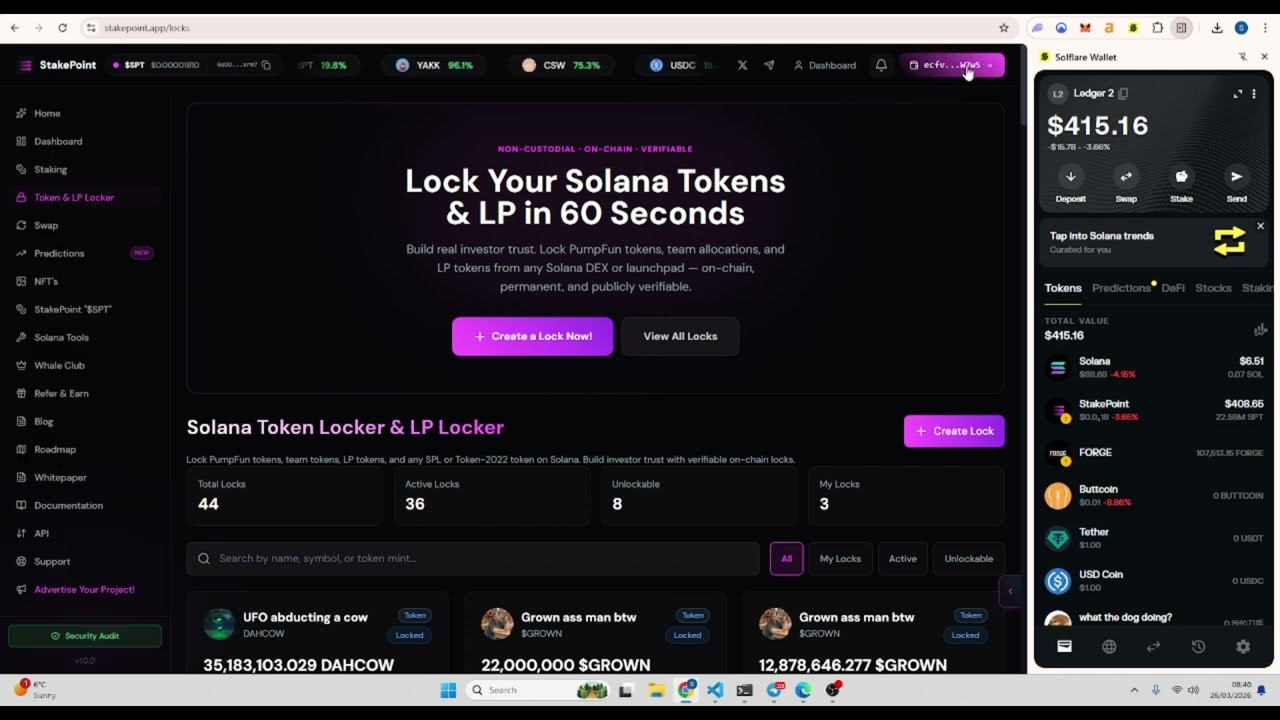
How to Lock Tokens on Solana, StakePoint Walkthrough
How it works, step by step
Token locking is used by project teams to prove that dev wallets, team allocations, or LP tokens cannot be withdrawn for a set period. Investors can verify locks independently on-chain without trusting any third party.
Staking Pools
StakePoint's staking pools let any project create an on-chain staking contract for its token without writing code. Stakers deposit tokens into the pool, rewards accrue continuously from an on-chain accumulator, and both the staked tokens and the reward vault are held in Program Derived Addresses controlled only by the program. A pool can pay rewards in the same token or in a different one.
How it works, step by step
Staking pools are used by Solana projects to reward long-term holders and reduce circulating supply. Pools support SPL and Token-2022 tokens, same-token or dual-token rewards, and reflection mechanics for tokens that distribute to holders.
Token Vesting
Vesting releases tokens to a beneficiary gradually instead of all at once. The creator sets a cliff and a vesting period, the tokens sit in a PDA vault, and the beneficiary can claim whatever has vested at any point after the cliff. Vesting is for team, investor and advisor allocations. Locking is for liquidity and supply commitments.
How it works, step by step
Vesting gives investors proof that team and insider tokens cannot be sold early, with the release schedule visible on-chain rather than promised in a document.
Reward Token Locks
Some tokens distribute rewards to every holder, such as reflections or revenue share. A standard lock would leave those rewards sitting in the vault until unlock. A reward lock keeps the principal locked while letting the creator claim the rewards that arrive in the vault along the way.
How it works, step by step
Reward locks let project teams lock their holdings for credibility without giving up the holder rewards their own token pays out. Some reward programs skip program-owned accounts by default, so the lock vault address may need to be registered with the token's distributor first.
LP Farming
LP farming is a staking pool for liquidity provider tokens. A project creates a farm for its Raydium or Meteora LP token and funds it with its own token as the reward, so liquidity providers earn the project token on top of trading fees. The farm runs on the same staking engine and the same PDA vaults as a standard pool.
How it works, step by step
Farms are used to deepen liquidity by rewarding providers for keeping their LP in place, without the project needing to run its own emissions contract.
Locking From a Squads Vault
If a project treasury is held in a Squads multisig, tokens can be locked straight from the vault without moving them to a single wallet first. The lock is built as a Squads proposal, the signers approve it in the Squads app, and the vault becomes the owner of the lock. Unlocking later is also a Squad decision.
How it works, step by step
This keeps the multisig as the owner at every step. No hot wallet, no intermediate transfer, and nothing moves until the signers say so. Works for standard locks, LP locks, reward locks and vesting schedules.
Free On-Chain Tools
StakePoint also offers a set of free tools that run as single on-chain transactions from your wallet: token burn, airdrops and wallet analysis. There is no account and nothing is stored off-chain beyond a public record of the transaction.
How it works, step by step
Projects use the burn tool to prove supply reductions publicly and the airdrop tool to distribute tokens without scripts or third-party services.
Security Design
StakePoint's smart contract is an Anchor program deployed on Solana mainnet. The program ID is gLHaGJsZ6G7AXZxoDL9EsSWkRbKAWhFHi73gVfNXuzK, publicly verifiable on Solscan.
The smart contract was independently audited by CPK Solutions in October 2026, with every finding remediated and confirmed in a retest. The audit scope, retest summary and bug bounty terms are published on the security page. The upgrade authority for the program is controlled by a 3-of-4 Squads multisig with hardware wallet signers. This means no single person can modify the smart contract, any upgrade requires independent approval from multiple keyholders.
All locked and staked tokens are held in Program Derived Addresses. PDAs are on-chain accounts derived from the program, they have no private key and cannot be accessed outside of the smart contract rules. Only the original wallet can unlock tokens after the unlock time.
Frequently Asked Questions
What is StakePoint?
StakePoint is a non-custodial Solana DeFi platform for token locking, LP locking, and token staking. It was launched in December 2025 on Solana mainnet. StakePoint does not custody user funds, all tokens are held in Program Derived Addresses on-chain.
What is a Program Derived Address (PDA)?
A Program Derived Address is an on-chain Solana account that is controlled by a smart contract rather than a private key. Because PDAs have no private key, no individual, including StakePoint, can access the tokens inside them outside of the rules defined by the smart contract.
Is StakePoint non-custodial?
Yes. StakePoint never holds private keys, never takes custody of user tokens, and never requires KYC. All token locks and staking positions are held in Program Derived Addresses on Solana mainnet, verifiable by anyone on Solscan.
What token standards does StakePoint support?
StakePoint supports standard SPL tokens and Token-2022 tokens including those with transfer taxes, interest-bearing mechanics, and other extensions. LP tokens from Raydium, Meteora, Orca, and PumpSwap are also supported.
Does StakePoint support token vesting?
Yes. StakePoint supports token locking with a fixed unlock date and token vesting with cliffs and gradual linear release. Use locking for liquidity and supply commitments, and vesting for team, investor and advisor allocations.
How is the StakePoint smart contract secured?
The StakePoint smart contract has been independently audited by CPK Solutions. It is deployed on Solana mainnet and publicly verifiable on Solscan. The upgrade authority is controlled by a 3-of-4 Squads multisig with hardware wallet signers, no single party can modify the program unilaterally.
What happens when a lock reaches its unlock date?
Nothing moves automatically. After the unlock date the creator wallet connects, opens the lock page and withdraws the tokens. Until that wallet signs the withdrawal, the tokens stay in the vault. No other wallet, including StakePoint, can trigger it.
Can I lock tokens from a Squads multisig?
Yes. Choose Lock from Squads vault at the start of the lock flow, paste the multisig account address and set up the lock as normal. The lock is created as a Squads proposal, your signers approve it in the Squads app, and the vault becomes the owner of the lock. Unlocking later works the same way.
Do Token-2022 tokens with a transfer tax work?
Yes. The lock or stake records the amount that actually arrives in the vault after the token's own transfer fee, so the figure shown on the lock page is the real balance held on-chain.
Does claiming staking rewards reset my stake timer?
No. On the current staking engine, claim and stake timestamps are tracked separately, so you can claim rewards as often as you like without extending your minimum stake period.
Get Started on StakePoint
Lock tokens, lock LP, or explore staking pools, all on-chain, all non-custodial, all verifiable.